

Updated September 17, 2026. This report uses the latest available official data. Figures are reported losses, not estimates of all fraud.
Americans reported 23,159 confidence and romance scam complaints and $929.3 million in losses in 2025, according to the FBI Internet Crime Complaint Center. That was a 29% increase in complaints and a 38% jump in reported losses from 2024. The average reported loss was about $40,126 per complaint, but averages hide a wide range of harm.
This page separates comparable datasets instead of adding them together. FBI, FTC and overseas agencies use different categories and reporting pipelines, so their totals overlap or describe different populations.
2026 romance scam statistics: the key numbers
| Measure | Latest figure | Source period | Source |
|---|---|---|---|
| U.S. confidence/romance complaints | 23,159 | 2025 | FBI IC3 |
| U.S. reported losses | $929.3 million | 2025 | FBI IC3 |
| Annual change in U.S. complaints | +29.3% | 2024-2025 | Calculated from FBI IC3 |
| Annual change in U.S. losses | +38.3% | 2024-2025 | Calculated from FBI IC3 |
| Age 60+ U.S. complaints | 10,188 | 2025 | FBI IC3 |
| Age 60+ U.S. losses | $584.0 million | 2025 | FBI IC3 |
| Likely AI-linked U.S. romance scam losses | Over $19 million | 2025 | FBI IC3 |
| Australia Scamwatch reports | 3,432 | 2025 | National Anti-Scam Centre |
| Average Australian Scamwatch loss | A$21,573 | 2025 | National Anti-Scam Centre |
U.S. losses rose much faster than complaints
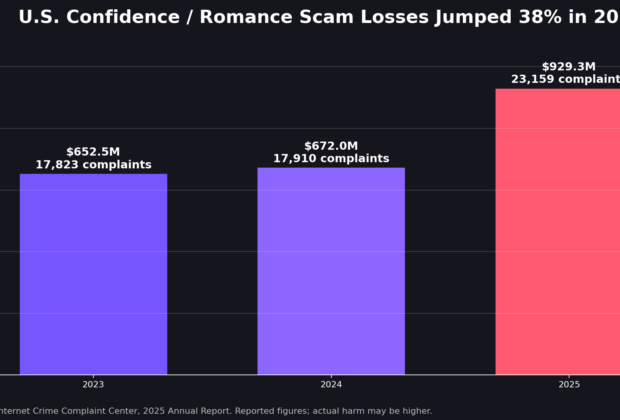
FBI data show a clear step-up in 2025. Confidence/romance complaints moved from 17,823 in 2023 to 17,910 in 2024, then 23,159 in 2025. Reported losses rose from $652.5 million to $672.0 million and then $929.3 million.
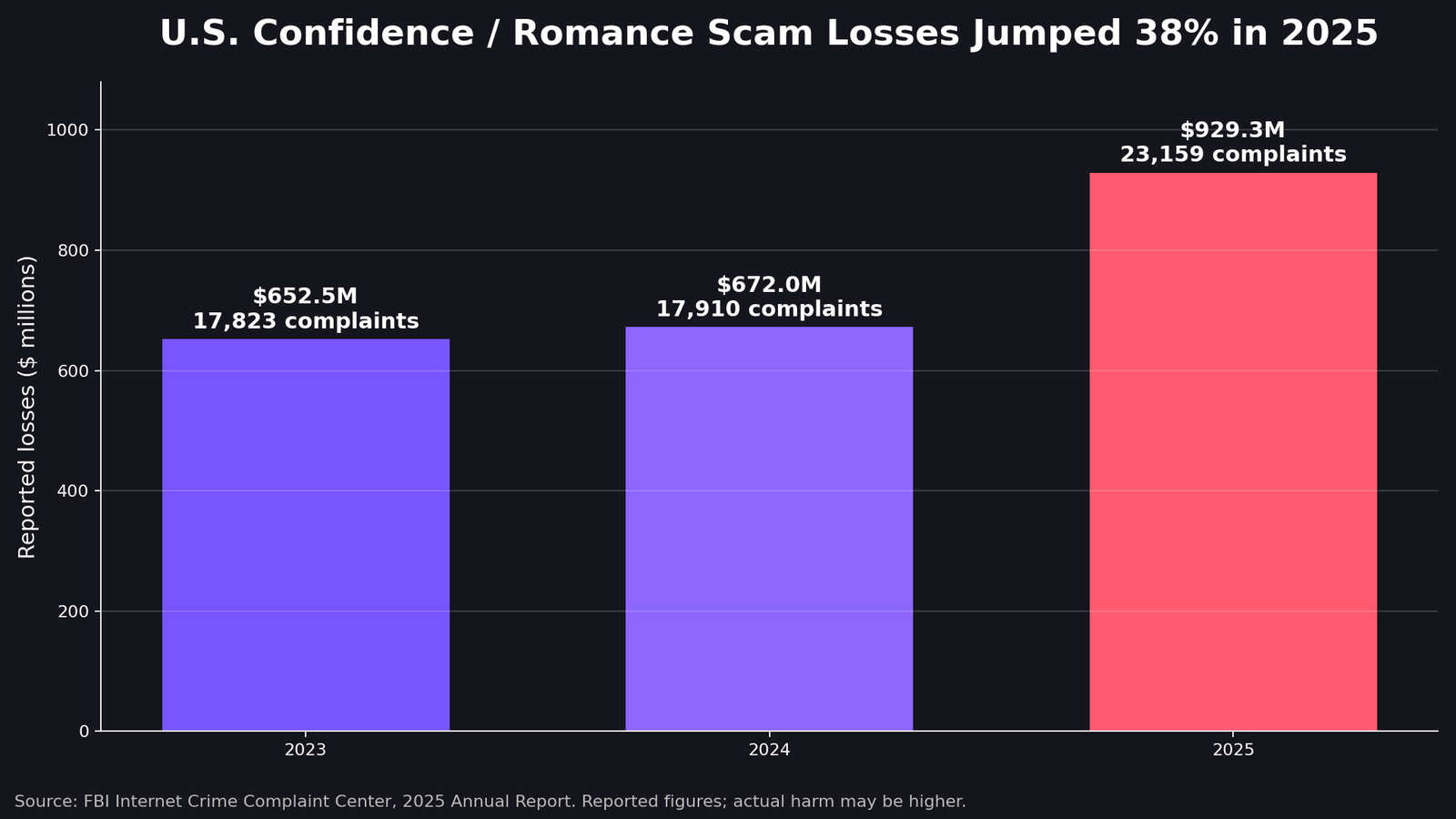
The implied average loss per complaint increased from roughly $37,521 in 2024 to $40,126 in 2025. That does not mean every victim lost $40,000. A smaller number of very large losses can pull the average upward.
Older adults carried most of the reported dollar loss
People age 60 and older submitted 10,188 confidence/romance complaints in 2025, 44% of the national count. Their reported losses were $584.0 million, about 63% of the total. Within the 60+ group, losses increased from $389.3 million in 2024 to $584.0 million in 2025.
This does not mean younger people are safe. Sextortion and social-media approaches can disproportionately affect younger users, while older victims may have more accessible savings and therefore suffer larger dollar losses.
AI is making fake relationships more convincing
The FBI recorded more than 22,000 complaints and $893 million in losses across all fraud reports with AI-related information in 2025. Within confidence/romance scams, victims reported more than $19 million in losses with a likely AI nexus.
Criminals use generative AI to improve scripts and translations, create realistic profile photos, and produce voice or video that supports a fake identity. A polished profile, good grammar or a convincing voice note is no longer proof that a person is real.
Where romance scams start
Romance fraud is not limited to dating apps. The FTC's detailed 2022 study found that 40% of people who reported losing money and named a contact method said the approach began on social media; 19% said it began on a website or app. Roughly 40% of long narratives mentioned WhatsApp, Google Chat or Telegram as scammers moved conversations off the original platform.
Australia's National Anti-Scam Centre recorded more than 70 dating platforms in 2025 romance scam reports. Frequently named dating services included Tinder, Plenty of Fish, Hinge, Grindr, Bumble and eHarmony, while social approaches included Facebook, Instagram, TikTok, Snapchat, YouTube and X. A platform appearing in reports does not prove it caused the fraud; large platforms naturally appear more often because more people use them.
How the money leaves
The FTC found that cryptocurrency and bank wires together accounted for more than 60% of reported romance scam losses in its 2022 dataset. Gift cards were the most frequently named payment method, appearing in 24% of loss reports with a method.
The common investment version is sometimes called romance baiting. After building trust, the scammer sends the victim to a fake cryptocurrency platform that displays false profits. A small early withdrawal may work. Later, larger deposits are locked behind invented taxes, fees or minimum balances.
The typical romance scam sequence
- Identity setup: a stolen or AI-generated profile appears on a dating, social, gaming or fitness platform.
- Fast trust: frequent compliments and intense attention create pseudo-intimacy.
- Isolation: the person asks to move to an encrypted messenger and discourages outside scrutiny.
- The financial story: an emergency, travel problem, package fee or “investment opportunity” appears.
- Escalation: requests grow, sometimes pushing loans, asset sales or retirement withdrawals.
- Exit or threats: the profile disappears, or intimate images become material for sextortion.
- Recovery scam: someone claiming to recover the lost funds asks for another upfront payment.
Red flags ranked by urgency
Stop immediately
- They ask for cryptocurrency, a bank wire, gift card codes or access to your account.
- They direct you to an investment platform or “coach” you through a transaction.
- They threaten to share intimate images or personal information.
- They ask you to receive or move money or parcels for them.
Verify before continuing
- They avoid live, unscripted video or repeatedly cancel an in-person meeting.
- They push the conversation off-platform very quickly.
- The relationship becomes intense before basic facts can be verified.
- Their photos have no normal history, or reverse-image search finds another identity.
- Their story changes around work, location, family or travel.
What to do if you sent money
- Stop contact and do not pay a “recovery” service.
- Contact your bank, card issuer, payment app or crypto exchange immediately. Speed matters.
- Save profiles, usernames, messages, wallet addresses, transaction records and dates.
- Report the profile to the platform.
- In the U.S., report at IC3.gov and ReportFraud.ftc.gov. In the UK, use Action Fraud. In Australia, use Scamwatch.
- If account or identity data were shared, change credentials and consider a credit freeze.
Why FBI and FTC numbers should not be added
IC3, the FTC Consumer Sentinel Network and overseas reporting systems collect different reports and apply different categories. Some reports may flow between systems, while others do not. The FTC has also changed whether IC3 data were included in some romance-scam spotlights. Adding headline totals can double-count harm. Trend comparisons are safest within one source and one definition.
Methodology
We extracted confidence/romance complaint and loss tables from the FBI's 2025 IC3 Annual Report and compared its 2023-2025 series. Percent changes and averages are arithmetic derived from those published figures. Contact-channel and payment-method shares come from the FTC's 2022 romance scam spotlight because it remains the agency's detailed published breakdown. International figures are reported separately. The page will be updated when agencies publish revised data.
For safer discreet dating, see our affair dating safety guide and reviews of Ashley Madison and Victoria Milan.