

Ask ten people where cheating starts and you will get ten different answers. Sex, obviously. But what about the coworker your partner texts every night and then deletes the thread? The ex they still follow? The "work wife" who knows more about their bad day than you do?
Researchers have started putting numbers on those arguments, and the results say the definition of cheating has quietly moved. Physical affairs are holding steady at roughly the same rate they have been for three decades. What changed is everything short of physical - and Americans are far less forgiving of it than you might guess.
We pulled the most recent national surveys and platform data to map where the line actually sits in 2026.
The new line: most Americans say you don't need to touch anyone to cheat
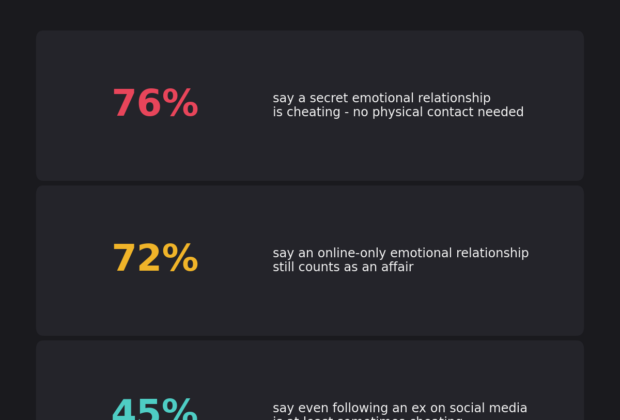
The cleanest data on this comes from a 2024 national sample of 2,000 U.S. adults analyzed by the Institute for Family Studies. Asked whether a married person having a secret emotional relationship counts as cheating, 76% said yes. Take the physical world out of it entirely - a relationship that exists only online - and 72% still call it an affair.
The gray zone is where it gets interesting. Following an ex on social media? 45% say that's at least sometimes cheating. Watching porn alone draws a "sometimes yes" from 28%, per the IFS digital-media analysis. A generation ago none of these questions existed. Now they're the ones couples actually fight about.
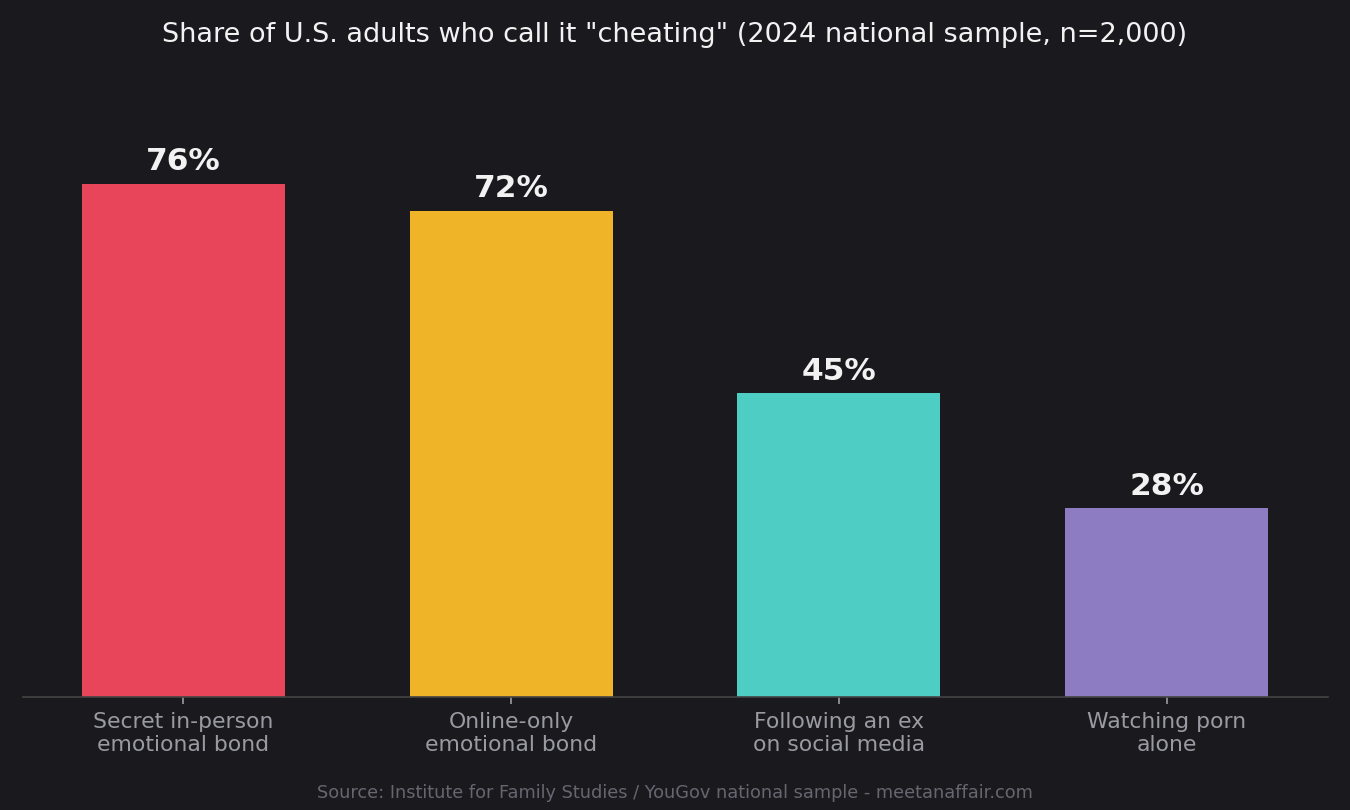
Read that top number again. Three out of four Americans believe an affair can happen with zero physical contact. That is a definitional shift, not a marginal one.

- 80M+ members worldwide
- Live cams and chat rooms
- Explicit profiles welcome
- Free to browse

- Millions of real members
- Discreet photos and privacy tools
- Coin based billing
- Mobile app

- AnonymousBlur photo tool
- Panic button
- 6M+ members
- Verified profiles
How common is physical cheating, actually?
The baseline number has been stable for decades. The General Social Survey - the gold-standard, nationally representative poll running since 1972 - puts lifetime infidelity among ever-married Americans at about 20% for men and 13% for women, per the IFS analysis of GSS data by research director Wendy Wang.
Two wrinkles worth knowing. First, the gender gap has nearly closed among the young: among adults under 30, women now cheat at slightly higher rates than men, a reversal of the historical pattern. Second, the overall trend is quietly pointing down for men. Wang's August 2025 update found that about 1 in 5 ever-married men reported extramarital sex in the 1990s and 2000s - a share that fell to 17% in the following decade.
Polling that includes dating relationships, not just marriages, lands in the same neighborhood. YouGov's 2025 survey found one in three Americans admit they have been unfaithful to a partner - and roughly half say it has happened to them.
Clinical literature casts a wider net: reviews of American marriage studies put the share of marriages touched by infidelity at 20 to 40%, depending on definitions and whether emotional affairs count. Definition arguments aren't academic. They change the headline number by a factor of two.
The platforms saw it coming
If you want a behavioral measure of demand, watch where people sign up. Ashley Madison - the site that survived the most damaging data breach in internet history - reports 91 million members joined since 2002, per its own 2026 homepage. It is still adding users in markets where it barely existed five years ago.
The sharper story is Gleeden, the affair app built for women. In India alone it crossed 4 million users, with women driving the growth, according to Global Dating Insights and the Economic Times. Bengaluru alone accounts for 18% of its Indian base. An app for married women, growing fastest in a market where arranged marriage remains the norm - that is what a cultural shift looks like in signup data.
And the demand spikes are now headline-driven. After the Coldplay concert kiss-cam scandal in July 2025, the UK's IllicitEncounters reported a 31% spike in sign-ups from what it described as high-profile professionals, per the Evening Standard. Scandal doesn't suppress the market. It advertises it.
- 80M+ members worldwide
- Live cams and chat rooms
- Explicit profiles welcome
- Free to browse
- Millions of real members
- Discreet photos and privacy tools
- Coin based billing
- Mobile app
- AnonymousBlur photo tool
- Panic button
- 6M+ members
- Verified profiles
Emotional affairs hurt differently - and researchers can measure that
One of the largest datasets on this comes from a Psychology Today online study of 94,943 people. Men were more likely to report sexual infidelity, and to do it more than once. Women were more likely to report emotional involvement. The caveat matters: it's a voluntary online sample, not a national poll, so treat the exact percentages with care. But the directional split - men skew physical, women skew emotional - shows up across nearly every study in this space.
The industry has noticed where the energy is going. "Polyamory and ethical non-monogamy used to be considered niche, but for Gen Z, they're simply part of the dating landscape," says Jessica Leoni, sex and relationships expert at IllicitEncounters. When the affair sites start sounding like sociology departments, the culture has moved.
There's a darker read of the same data. If 76% of people count secret emotional intimacy as cheating, then the millions of people in exactly those arrangements - the deleted threads, the renamed contacts - aren't in a gray zone at all. They're having affairs by their own neighbors' definition. The label just hasn't caught up with them yet.
What happens after: the survival numbers
Discovery isn't automatically the end. Popular clinical summaries put the share of couples who stay together after an affair comes to light at roughly 45 to 75% - a wide range, because outcomes depend heavily on whether the affair is disclosed or discovered, and whether both people do the repair work. Among couples who enter therapy after infidelity, about two-thirds improve, per outcome studies of behavioral couple therapy published via the National Institutes of Health. The marriages that fail usually don't fail at discovery. They fail in the eighteen months of half-measures after it.
- 80M+ members worldwide
- Live cams and chat rooms
- Explicit profiles welcome
- Free to browse
- Millions of real members
- Discreet photos and privacy tools
- Coin based billing
- Mobile app
- AnonymousBlur photo tool
- Panic button
- 6M+ members
- Verified profiles
Who cheats: the demographic splits
The GSS data hides some sharp divides. Reported infidelity rises with age, and the peak arrives later for men than for women. Regular religious attendance tracks with notably lower reported infidelity than never attending. And Wang's 2025 analysis added a status finding: men in prestigious jobs - management, medicine, law, finance - cheat at higher rates than men in other occupations. Opportunity, it turns out, shows up in the data just like your grandmother said it did.
The under-30 reversal deserves its own mention. Young women now report slightly higher infidelity than young men - the first cohort in the survey's history where that's true. Researchers caution the gap is small and the sample thin, but the direction matches what the platforms report: the fastest-growing user segment on women-first affair apps is women.
Where the data is weak (and honest about it)
Every number in this piece carries a caveat, and you should want that. Infidelity research runs on self-reports - people lie to surveys about exactly this topic, and the GSS's own methodology notes treat its figures as floors, not ceilings. The 94,943-person Psychology Today dataset is a voluntary online sample: huge, but self-selected. Platform numbers like Ashley Madison's 91 million are lifetime sign-ups, not active users, and the company has every incentive to count generously. What's trustworthy is the direction: physical rates flat-to-down, emotional rates up, definitions expanding. Anyone who sells you a precise national cheating rate to one decimal place is selling something else.
What this means
Three takeaways from the data stack. First, physical infidelity is stable or slightly declining - the panic headlines outrun the GSS. Second, emotional and digital infidelity is where the actual growth is, and three-quarters of Americans already judge it as full cheating. Third, the platforms serving this demand are getting bigger, more female, and more global every year.
The definition of an affair expanded. The behavior didn't wait for permission.
Frequently asked questions
What percentage of married people cheat?
About 20% of ever-married men and 13% of ever-married women report having had sex with someone other than their spouse, based on General Social Survey data analyzed by the Institute for Family Studies. Broader reviews that count emotional affairs put the share of affected marriages at 20 to 40%.
Is an emotional affair really cheating?
Most Americans say yes. In a 2024 national sample of 2,000 adults, 76% called a secret emotional relationship cheating, and 72% said the same about a relationship that exists entirely online. The label no longer requires physical contact.
Is cheating becoming more common?
Not physically - the male rate actually fell from about 20% in the 1990s-2000s to 17% in the following decade, per IFS. What's rising is emotional and digital involvement, which is harder to measure but shows up clearly in platform growth: Ashley Madison reports 91 million lifetime members, and the women-first affair app Gleeden passed 4 million users in India alone.
Do marriages survive infidelity?
Often, at least initially. Estimates of couples staying together after discovery range from about 45 to 75%, and around two-thirds of couples who enter therapy after an affair improve. Full recovery typically takes years of structured work, not weeks of apologies.
Sources
- Institute for Family Studies - Who Cheats More? The Demographics of Infidelity in America (GSS analysis, Wendy Wang)
- Institute for Family Studies - 2025 GSS update on extramarital sex trends
- Institute for Family Studies - What Counts as Cheating in Marriage? (2024, n=2,000)
- YouGov - How many Americans have cheated on their partners?
- Global Dating Insights - Gleeden passes 4 million users in India
- Evening Standard - IllicitEncounters sign-up spike after the Coldplay scandal
- Psychology Today - The Truth About Infidelity (94,943-respondent study)